Chapter 2: Probing Questions, Socratic Questioning, AND More on DOK
In Rigor by Design, Not Chance, Karen Hess uses the 2nd chapter to explain the significance of asking probing questions. Hess supports this idea by saying, “The art of questioning is at the heart of good teaching and deeper learning” (p. 32). Probing questions are not asked to be responded to with concrete, 1 dimensional answer, but rather lay a guiding path in a student’s mind that will help them to establish their own mind map. Probing questions will encourage students to grapple complex concepts and actively engage with their own thought processes.
Hess categorizes questioning under two levels: closed-end questions for surface level understanding, and open-ended questions for deeper understanding. Closed-end questions are questions that you can physically open up a textbook and reread to find the specific answer, write it down, and you can feel good about your response. Open-ended questions often involve probing students to elaborate on a pre-conceptual belief or understanding, which may involve further research to enhance their knowledge on this topic or may require further elaboration to explain their opinion on an idea. This sounds very familiar to me…
In my previous post, I reflected primarily on Depth of Knowledge (DOK) and what it looks like across the curriculum. Hess’s description of closed and open-ended questions seems to be directly derived from the DOK model. A little further reading proved that my suspicion was correct! She Presents a table on page 39 that dissects different levels of questions regarding 1 topic as it progresses from closed questioning into more open ending questioning, in which you can observe that the more open-ended a response becomes, the higher DOK level it embodies. (Hess, 2023. Figure 2.1). Following this, she then relates different levels of probing questions to the Actionable Assessment Cycle, also discussed in chapter 1, attached below.
Looking at the long range of Questioning Strategies that she ties to the stages of the assessment cycle, I can say that I am certainly familiar with most of the terminology and strategies listed, at least superficially. However, there is 1 word that I have heard before, but just now realized I never knew the meaning of, and that is Socratic. She uses it in a few different ways, including Socratic questioning and Socratic circles. According to Hess, “Socratic questioning involves teaching students to ask their peers a range of different questions.” While she only elaborates on this topic for half of a page, I felt that this was a strong strategy, so I decided to do a little bit of outside research via a popular article.
In an article from Teacher Magazine, Steven Kolber, an 11-year veteran public school teacher with a passion for student collaboration, explores the benefits of Socratic circles (or as he also describes it, Socratic seminars). He described using Socratic circles in a different way than what Hess does. When he uses Socratic circles, he has an inside circle in an outside circle. Members of the ‘inner circle’ are actively involved in discussion with one another, whilst those in the ‘outer circle’ take notes, observe and notice patterns within this discussion. (Kolber, 2022). This then provides a means of the students to critique and assess each other.
Kolber also notes that there are 3 primary purposes of education: qualification, socialization, and subjectification. He defines qualification as the right to education, giving all people the right to a quality life. He describes socialization as providing students with opportunities to develop social skills necessary to be contributing members of society. He then describes subjectification as the right students have to exist as a subject of their own environment with freedom in their boundaries. (Kolber, 2022).
Socratic questioning embodies these ideals while providing ownership of education to the students. This all falls in line with Karen Hess’s descriptions of the benefits of probing questions. Hess asks the question, “why promote a shift from teachers asking of all the questions to teachers encouraging students to ask their own questions?” (p. 32). Kolber’s explanation and utilization of Socratic questioning provides a response to this rhetorical question through example of the process itself.
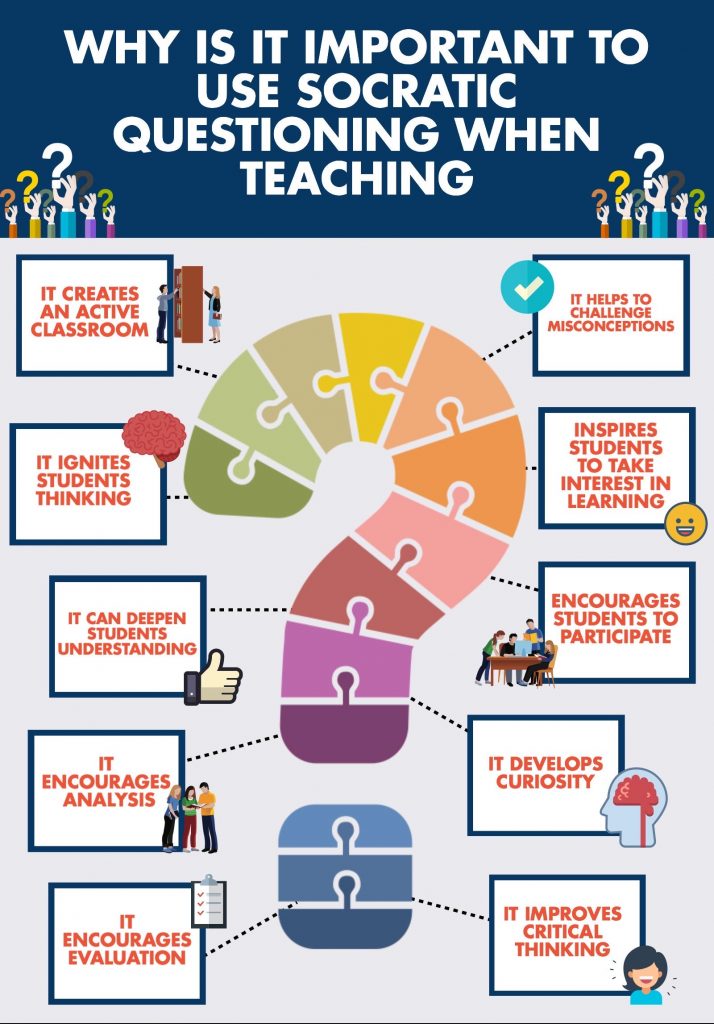
What I have come to realize is that Socratic Questioning embodies probing questions and open-ended response. It is designed to provide direct access to the complete range if Depth of Knowledge while being almost entirely student led. It is accessible at all grade levels, and can be adjusted to meet the needs of all students, no matter their level of understanding on a topic. However, Socratic questioning is not the only means of utilizing probing techniques in the classroom. Tying probing questions to different levels of DOK will encourage deeper thinking and understanding of academic concepts for students, which will eventually transfer into executive functioning skills.
References
Hess, Karin. (2023). Rigor by Design, Not Chance: Deeper Thinking Through Actionable Instruction and Assessment. ASCD ASSN SUPERV CURR DEV, 2023.
Kolber, Steven. (2022). “Classroom Teaching Techniques – Socratic Circles.” Teacher Magazine, www.teachermagazine.com/au_en/articles/classroom-teaching-techniques-socratic-circles.

ReplyDeleteRaena,
You have done an excellent job summarizing the key points from Chapter Two of "Rigor by Design Not Chance" and drawing a connection to Steven Kolber's ideas about Socratic circles. Both mention that Socratic seminars are an effective strategy for fostering critical thinking. Having not been exposed to Socratic seminars in my Field Experiences, I wonder how teachers balance between covering the necessary content and encouraging students to ask their questions. Referring to a previous discussion forum from EMR502, students in Ms. Wiggin's class led a book discussion without the teacher constantly intervening to pose questions of her own. What are some strategies that can assist teachers with leading effective Socratic seminars?